The Tell in the Portfolio: When a Signature Move Starts Making Decisions for You
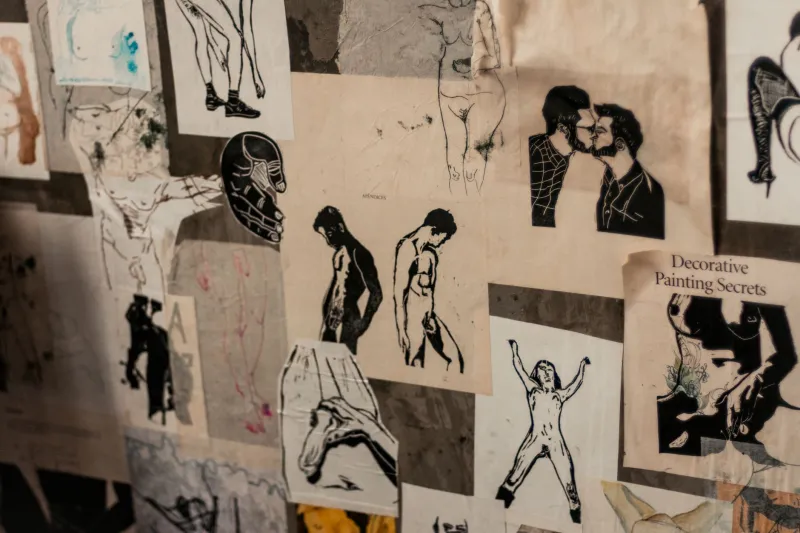
Every portfolio has a tell. It might be the same warm terracotta that turns up in every project, the slightly wonky grid that makes a layout feel hand-built, or a habit of drawing tiny arrows that point at nothing in particular. Individually, these moves look like choices. Across a whole body of work, they start to look like a signature — or a tic.
The difference matters. A recurring motif can be the thing that makes a portfolio recognisable in a crowded inbox. It can also be the thing that makes an art director think, 'I know exactly what this will look like before I open the file.' In 2026, with more work than ever being scanned quickly on a screen, UK creatives are thinking harder about the marks they repeat and what those marks are doing for them.
The Comfort of the Repeat
Most repeated moves begin as shortcuts, not statements. A Bristol-based illustrator told me she started drawing the same three-quarter profile in her second year of university because it was the only angle she could get right before a deadline. Ten years later, it is still there — in editorial commissions, in a book cover for a small Welsh press, in the poster she made for a Salford music venue. 'It is not laziness,' she said. 'It is like a favourite mug. I know how it feels in my hand.'
That sense of ease is part of the appeal. Repetition reduces friction. It lets a maker get to the interesting part of a project faster, whether that is colour, texture or an awkward idea that needs a familiar shape to hold it. A Glasgow-based designer described his repeated use of a heavy rule line as 'a bit of scaffolding — it stops the page wobbling.' He has tried removing it. The work felt untethered. He put it back.
There is also a commercial logic. Clients often come back for the thing they saw last time. A Cardiff maker who works in cast concrete said that galleries now ask for 'the one with the curved lip' because that is what sold in 2024. The curve has become a product line. That is not necessarily bad. It pays for the studio. But it does mean the signature move is no longer only an artistic decision; it is a small business decision too.
When the Tell Becomes a Trap
The trouble starts when the repeat stops being a tool and starts being a filter. One Peckham-based art director described opening a folio and seeing the same composition six times in a row — object centred, shadow to the left, a single leaf entering frame right. 'I could not tell if the work was versatile or if the same drawing had been recoloured,' she said. 'That is the moment I stop reading and start scrolling.'
For the maker, that drift can be hard to see. You are inside the habit. You know the variations. You remember the difficult commission where the usual move did not work and you had to invent something else. The portfolio, though, flattens all that context. It shows the surface pattern, not the thinking.
A Sheffield illustrator who teaches part-time said she now asks students to lay every project end to end on the floor and look for the 'uninvited guest' — the element that appears even when the brief did not ask for it. 'Sometimes it is a colour,' she said. 'Sometimes it is a way of cropping. Sometimes it is a joke that only works if you know their work. The point is not to ban it. The point is to see it.'
What Collaborators Actually See
Collaborators are not automatically bothered by repetition. Editors like reliability. A book designer knows that a certain illustrator will deliver a certain kind of warmth. A gallery knows that a maker's work will sit together in a room. The problem is not the tell itself; it is the absence of contrast.
A Manchester-based curator put it neatly: 'I want to see the signature move and then I want to see what happens when they cannot use it.' That might mean a project where the usual palette was off-limits, or a commission that forced a different scale, or a self-initiated piece that deliberately sets the habit aside. The tell becomes more interesting when it has a shadow — a body of work that shows what the maker does without it.
Some creatives are now building that contrast into their portfolios on purpose. One Leeds illustrator includes a small 'B-sides' section: experiments, failed tests, pieces where the usual marking was banned. It is not the main event, but it signals range. Another designer, based in Margate, rotates the order of projects every few months so that the first thing a visitor sees is not always the most on-brand piece. 'It stops the portfolio from becoming a greatest hits album,' he said.
Editing the Habit, Not Killing It
The healthier approach is rarely to stamp out the repeat. Most signature moves are load-bearing. Remove them entirely and the work can lose its voice. The trick is to keep the move conscious. Ask what it is doing in each project. Is it solving a problem, or is it filling a gap? Is it a pleasure, or is it a reflex?
A few practical habits come up again and again in conversations. Put the usual mark on a one-project holiday. Make a piece where the tell is allowed only once, and see what rushes in to replace it. Show the portfolio to someone who does not know your work and ask them to describe the pattern back to you — not to judge it, but to name it. Often they will spot the thing you stopped seeing years ago.
For Isabel KM, that feels like the right way to think about a creative portfolio in 2026: not as a museum of the same move, but as a living record of a practice in motion. A signature is not a brand asset. It is a conversation between what you love doing and what the work actually needs. The tell can stay. It just should not be the only thing telling the story.