The Flops That Stayed: UK Illustrators and Designers on Work the Feed Forgot
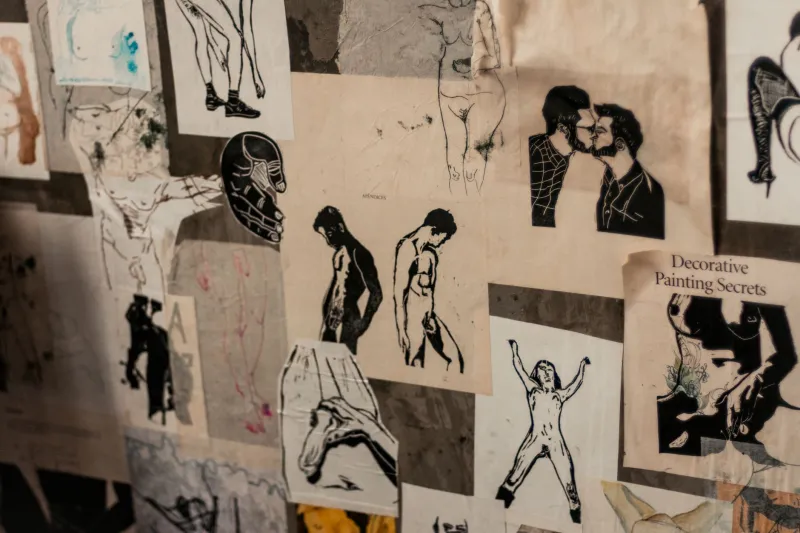
There is a particular kind of silence on the internet. You post a project you love, the algorithm shrugs, and the work sits there like a party guest nobody introduced. For years, the sensible advice was to bury it. In 2026, a growing number of UK illustrators and designers are doing the opposite: they are pulling the flops back into the portfolio, giving them context, and letting them do a job the feed never allowed.
At Isabel KM, this is the kind of archive behaviour we like. Not nostalgia. Curation. The failed post becomes a case study. The odd commission becomes a door-opener. The thing that did not pop becomes the thing that explains your practice better than the hit ever did. Here are five UK makers doing exactly that.
1. The taxidermy pigeon poster that became a studio identity
Bex Linton, an illustrator in Sheffield, made a poster for a fictional natural history museum. It featured a pigeon in a tiny waistcoat and a caption about civic pride. On Instagram it got 43 likes and a comment from her mum. She nearly deleted it. Two years later, a small museum in Yorkshire saw it in a forgotten corner of her portfolio and asked her to design a family trail. The poster is now the first image on her site. 'It was too weird for the feed and exactly right for the job,' she says. The portfolio gives it context: the brief, the joke, the failed print test. That context is what made it useful.
2. The brand system that was too quiet to screenshot
Hammad Iqbal, a designer in Birmingham, spent six weeks on a visual identity for a community bakery. The launch carousel flopped. The work was restrained, typographic, and almost impossible to compress into a square. He kept it on his site anyway, with a long note about the shop's queue system and the way the signage had to work at 6am. A year later, a housing association commissioned him for a wayfinding project. 'The bakery showed I could do quiet work in a loud place,' he says. The feed wanted a punchline. The portfolio wanted a process.
3. The sketchbook that was not a product
Mara Osei, a designer and maker in Bristol, posted a series of loose sketchbook pages. They were not a launch, not a drop, not a product. They got low engagement. She stopped posting them. Then she made a page on her site called 'Pages that did not become anything' and included twelve of them with short notes. A publisher saw the page and asked her to illustrate a book about city gardens. 'The sketchbook was the honest version of my taste,' she says. 'The site let it be a resource rather than a performance.'
4. The animation that was too slow for the scroll
Imani Clarke, a motion designer in London, made a 90-second animation about a bus route. It did badly on social because it was slow. She put it on her portfolio with a shot list and a note about the sound design. It became a client door-opener for a transport charity. 'People do not watch slow work on the feed,' she says. 'They watch it when they are deciding whether to trust you.'
5. The ceramic series that looked like a mistake
Gwen Meredith, a ceramicist in Cardiff, made a series of bowls with slumped rims. The photos did not perform. She included them in a portfolio page called 'Failures with potential' and wrote about the kiln schedule. A restaurant group asked for a tableware range. 'The flop was the most specific thing I had,' she says. 'The feed flattened it. The portfolio let it be specific.'
What the feed could not do
The pattern is not that every flop is secretly a winner. Some work is just bad, or early, or for the wrong room. The point is that the feed is a terrible editor of context. It rewards the immediate, the legible, the screenshot. A portfolio can reward the slow, the odd, the useful. It can say: this did not work here, but it might work for you. That is not spin. It is curation. And in 2026, with so much work disappearing into the scroll, the portfolio is becoming the place where the work gets a second chance. Not because it went viral. Because it finally has room to explain itself.