The Portfolio That Never Finishes: Why UK Creatives Are Building Living Archives
The showreel had a good run
For a long time, the creative portfolio was a closing argument. You did the work, chose the best six pieces, paid a designer, and pressed publish. The site sat there like a laminated CV: clean, controlled, finished. It made sense in a world where commissions arrived through gatekeepers and a portfolio was something you sent, not something you kept.
In 2026, that model feels increasingly out of step with how UK creatives actually work. Freelance careers are lumpier. Collaborations cross cities and time zones. A single project can move from a funding application to a workshop to a print run to a panel talk. The old showreel can't hold that shape. So the portfolio is changing — from a trophy cabinet into a living archive.
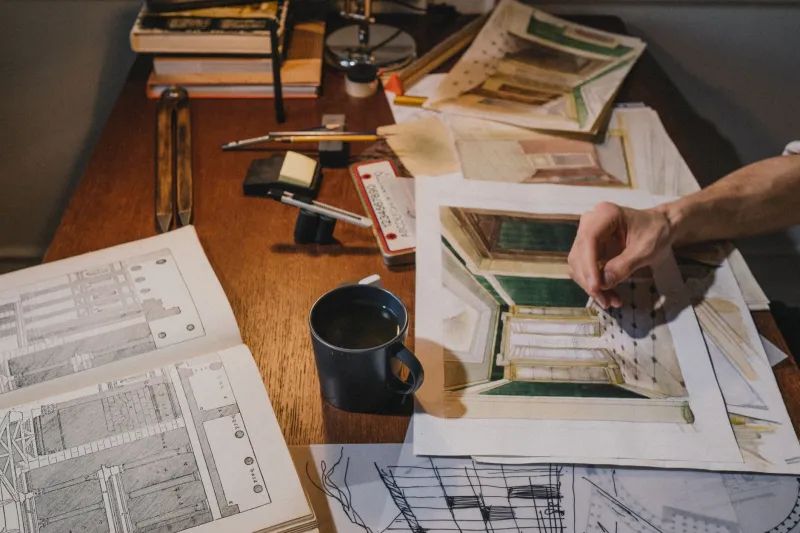
A portfolio should behave like a sketchbook
The most interesting creative sites right now don't look like catalogues. They look like working documents. There are dated notes, process shots, half-finished ideas, credits, references to place. A ceramicist in Stoke might post glaze tests alongside a finished commission. A graphic designer in Belfast might log a typographic walk through the city. A theatre maker in Cardiff might share a rehearsal room sketch next to a funding report.
This is not about posting everything. It's about letting the site carry evidence of thinking. A living portfolio says: here is what I'm exploring, here is who I'm exploring it with, here is where it happened. That is a very different signal from a highlight reel. It tells collaborators and commissioners that you are active, curious and connected, not just well-presented.
Visual identity gets stronger when it breathes
A common worry is that an evolving portfolio will look messy. In practice, the opposite can happen. The sites that work best have a clear visual system — a typeface, a colour palette, a grid, a tone — and then allow the content to move inside it. The identity becomes a container rather than a costume.
That is a more honest way to brand a creative practice. UK audiences are used to seeing polished feeds. They are less used to seeing the joins. A living portfolio can show a screen print in progress in Leeds, a sound test in Glasgow, a community workshop in Bristol. The visual identity holds those fragments together without pretending they are all finished. For artists and makers, that flexibility is useful. It means the site can grow without a full redesign every eighteen months.
Funding applications need a paper trail
Anyone who has applied to Arts Council England, a trust or a local authority knows the scramble. You need evidence of process, partners, outcomes, audience. If your portfolio only shows final work, you end up reconstructing the story from old emails and phone photos.
A living archive makes that story easier to tell. Project pages with dates, collaborators, workshop documentation and short reflections become a record you can draw on. It also makes applications feel less like a performance of worth and more like a continuation of the work. Funders are not just buying a polished PDF; they are seeing a practice that documents itself as it goes.
There is a risk of turning the site into admin. The trick is to keep it light. A few images, a paragraph, a date, a credit. You are not writing a report every week. You are leaving a trail.
Audience trust is built in public
There is a quieter benefit too: trust. A portfolio that shows process, credit and place feels more human than a feed of perfect outcomes. People can see the collaborators, the context, the mistakes that got edited out. For UK audiences who are tired of manufactured slickness, that matters.
This is especially true for local and community-facing work. If a project happened in a specific neighbourhood, a living portfolio can name the partners, the venue, the people involved. It can show the research and the conversations. That is not just good branding. It is a form of accountability. It says: this work came from somewhere, and here is the somewhere.
Keep it alive, not exhausting
The living portfolio is not a demand to post daily. It is a permission to be unfinished in public. A site can be updated monthly, seasonally, or when a project reaches a useful checkpoint. The point is that it reflects a practice in motion rather than a past self.
At Isabel KM, that is the approach we are interested in: a personal creative portfolio that behaves like a working archive, not a frozen brochure. It can hold finished pieces, yes, but also notes, collaborations, experiments and local references. It can be a sketchbook, a calling card and a directory of people and places, all at once.
The static showreel isn't dead. It still has a place for some commissions and some audiences. But in 2026, the more useful question is not 'does this look finished?' It is 'does this look alive?' For UK creatives, the answer increasingly lives on a site that keeps moving.